|
FOREWORD
Madeleine K. Albright
THIS IS A BOOK ABOUT HOPE,
based on reality.
IT
RESTS ON THE PREMISE that the ancient enemies of human
progress — poverty, ignorance, and disease — can be
defeated, or at least forced to retreat, through the mpowerment
of women and girls. As evidence, this book presents not a wealth
of statistics or a detailed explanation of a complex economic model.
Instead, it offers the stories of some remarkable women who are
working every day to transform their communities and build a brighter
future for their families.
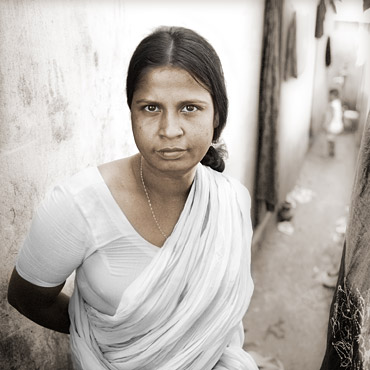
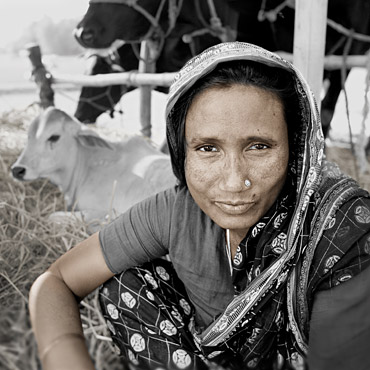
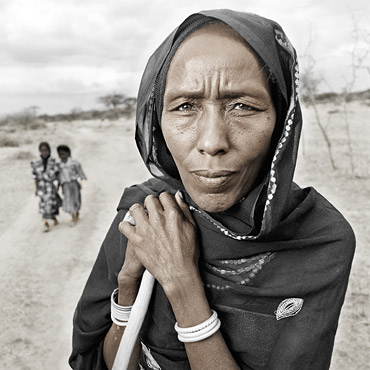
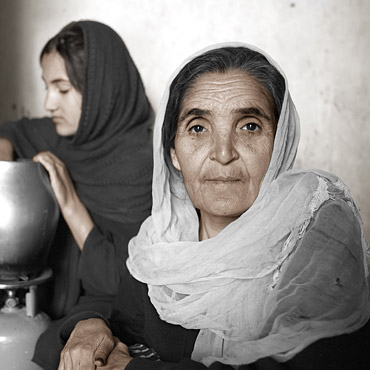
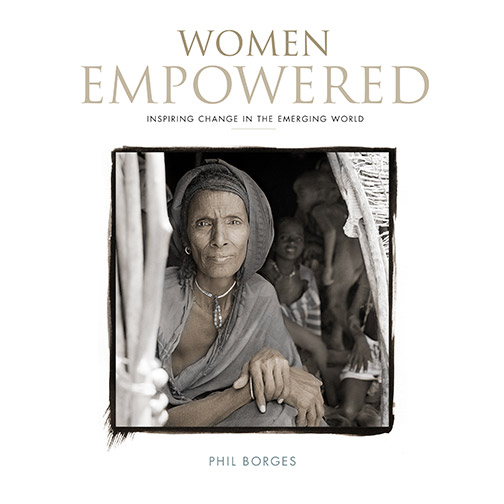
THROUGH THE STUNNING PHOTOGRAPHY and straightforward
commentary of Phil Borges, readers come to know how women such as
Fahima in Afghanistan, Abay in Ethiopia, Hasina in Bangladesh, and
Violeta in Ecuador are improving and enriching their own lives,
and those of the people around them.
THE EXPLOITS OF THESE WOMEN are not detailed in
the newspapers or featured on headline television
news. Their contributions occur off-camera, in remote villages and
crowded neighborhoods. But taken
together, their efforts and those of millions like them have immense
power. Experience has shown that when women have the freedom to
make their own economic and social choices, the chains of poverty
can be broken; families are strengthened; income is used for more
productive purposes; the spread of sexually transmitted disease
slows; and socially constructive values are more likely to be handed
down to the young.
CYNICS HAVE LONG SUGGESTED that development assistance,
so easily dismissed as ”foreign aid,”
is money down a rat hole. The truth is that programs that are poorly
designed, transitory, insensitive to local conditions, or overly
politicized are doomed to fail. But programs that enable or encourage
women to participate more fully in the economic and political life
of their societies have a strong record of success. I have seen
this myself in traveling throughout the emerging world, where experts
from humanitarian organizations such as CARE have identified strategies
that consistently lead to positive results.
THROUGH DECADES OF OBSERVATION and study, these
experts have learned that reproductive
health services can save the lives of millions of women and children,
and lead to better long-term health for entire families. They have
learned that ensuring access to basic education for girls provides
the firmest possible foundation for social development. They have
learned that training women to employ low-cost measures to protect
against unsafe water or disease-carrying insects can dramatically
improve public health. They have learned that village savings and
loan groups can enable women to start small businesses, create jobs,
and begin to accumulate capital. They have learned that working
for change does not mean simply imposing one’s views on another,
and that harmful practices, such as female circumcision, are best
countered not by blunt condemnation but by reasoned explanation,
in which the religious and cultural justification for the customs
are analyzed, the pain caused by the process is fully understood,
and a new consensus is reached.
FINALLY, THESE EXPERTS have learned that the
subjection and sidelining of women in the twenty-
first century is not only wrong, but also economically unsustainable.
No country can make progress if half
its population is held back, left out, or pushed aside. Men and
women, girls and boys, must go forward
together.
WOMEN IN POOR COUNTRIES inevitably play a central
social role. Because of the obstacles many
face, they also have a strong interest in ensuring that knowledge
is shared. This is why poverty-fighting
projects that focus on women are so constructive; each becomes a
platform for further gains.Women are
eager to explain what they have learned to their children and neighbors.
Archana Kundu, a mother and
member of a CARE-supported women’s self-help group in rural
India, put it this way: “For us to have a
better life, the people around us have to have a better life. You
just can’t have a good life when people
around you are unhappy.We have a moral responsibility to support
the women around us. I enjoy doing it.
Now I know so much, I want to share it.”
AS THE U.S. SECRETARY OF STATE, I was privileged
to represent my country in nations around the
world. I had many meetings with high officials in fancy offices,
but those are not the meetings that I remember most. The people
I will not forget are those I encountered in refugee camps, rehabilitation
centers for amputees, safe havens for trafficked women, and clinics
for mothers with HIV/AIDS.These are the places where the human spirit
undergoes its toughest tests and where people live on less money
each day than most of us spend on a can of soda or a cup of coffee.
As the representative of the world’s richest and most powerful
nation, I was often asked for an assurance that these women and
their children would not be forgotten and that their experiences
would serve as a catalyst for change.
BACK IN WASHINGTON D.C., I was asked a different
question.Why should we care about fighting poverty in the emerging
world? I was told that the task was hopeless, that we could not
afford to undertake it, and that we had too many other problems
about which to worry. I replied that we had learned over and over
again that the gravest dangers to world security have deep roots.
Desperation, when allowed to fester, egets violence, ethnic strife,
terrorism, international crime, and the forced displacement of people.
Development, on the other hand, provides the basis for broader markets,
new democracies, stability, and peace.
I BELIEVE DEEPLY that if the developed world
did more to help the deserving, especially women, we would see children
everywhere become citizens and contributors; we would see young
people put down roots and establish a niche in the global marketplace;
and we would see whole countries benefit from the energy and skills
of all their people. The good news, in which democratic societies
have always believed, is that human security, prosperity, and freedom
are dynamic, not finite; if we plant the seeds and till the soil,
they will grow. Here an organization like CARE is essential, for
its very purpose is to cultivate, nourish, and sustain our faith
in each other and in ourselves.
UNDERLYING ALL THIS is the simple view that every
individual—male or female—counts. This is the philosophy
of democracy at its best, and it has been the driving force for
six decades behind the work of CARE. THIS VIEW IS NOT BASED ON ANY
ILLUSIONS; humanitarian workers, in particular, have seen far too
much of tragedy and death to indulge in sentimentalism. But we live
in a world that has been immeasurably enriched by the survivors,
by those who have lifted themselves out of poverty and have overcome
hardships to blaze new trails to success.
THESE PAGES INTRODUCE A SMALL SAMPLING of such
pioneers and pathfinders.We learn their names and see their faces,
and witness the work of their hands and minds.We are encouraged
and inspired, and filled with hope.We are also challenged to consider
what we can do—each in our own way— to create a world
more free, prosperous, and humane than it has ever been.
|